
Women.Life.Climate
Exhibition Aug 7 – 18.9.2026
⇓ Full Press Release (pdf)
⇓ Short Press Release (pdf)
⇓ Flyer
Group Global 3000 Shows International Art on Women, Climate Crisis, and Social Change
Berlin, August 7, 2026. The Group Global 3000 gallery dedicates its 71st exhibition to the relationship between women, the climate crisis, and social responsibility. Under the title “Women. Life. Climate.”, 18 international artists will present works from the fields of video, virtual reality, painting, drawing, installation, and performance from August 7 to September 18, 2026.
Based on the political slogan “Women. Life. Freedom.”, the exhibition focuses on women worldwide who are committed to climate protection and ecological change. The artistic positions address activism, power structures, gender roles, care, and motherhood, as well as global resource distribution and the relationship between humans and the environment. Both visible actors and often invisible engagement in science, politics, and everyday life are highlighted.
Participants include Stephan Groß, Gosia Hejnat, Janet Grau, Maria Korporal, Andrea Striesova, Barbara Schwinges, Ivonne Portillo Sierra, Sandra Becker, Erika Szentgyörgyi, Judith-H. Boy, Monika Thorwart, Elma Riza, Aleksandra Sawa, Ekaterina Kovalenko, Alina Tofan, Jiaxiao Ji, Lioba von den Driesch, and Robin Romanski.
The exhibition is accompanied by an extensive program including artist talks, a panel discussion, lectures, and performances. During Berlin Art Week from September 9 to 13, the exhibition is open daily from 5 PM to 8 PM.
Exhibition at a Glance
Women. Life. Climate
August 7 – September 18, 2026
Group Global 3000 e. V.
Leuschnerdamm 19, 10999 Berlin
Opening hours: Tuesday and Friday, 5 PM–8 PM
During Berlin Art Week: September 9–13, 2026 daily 5 PM–8 PM and during events.
Guided tours for school classes and adult groups are possible by arrangement.
Curator: Tom Albrecht
Co-curators: Andrea Striesova, Katja Hock
71st Exhibition of Group Global 3000
Press Contact:
Organization: Tom Albrecht
Events: Andrea Striesova
Content Contact: Katja Hock
Email: kontakt@gg3.eu
Website: gg3.eu
Program
We are accompanying the exhibition with a musical and dialogue-based programme.
- August 7, 2026, 7 PM – Opening Reception
Welcome: Tom Albrecht
Introduction to the exhibition: Katja Hock
Music: Puzzls
Performance: Cat Lady for Climate by Maria Korporal
Scream performance: Judith-H. Boy - August 14, 2026, 7 PM – Artist Talk
Participating women artists will explain their works and engage in dialogue with visitors.
Moderation: Katja Hock - August 21, 2026, 7 PM – Panel Discussion
Women from various climate professions talk about challenges, opportunities, and perspectives.
Moderation: Nathalie Wenker, sustainability expert
Participants: Prof. Dr. Stefanie Kaboth-Bahr, Professor of Paleoclimatology at FU Berlin; Dr. Andrea Nakoinz, physician and expert in climate resilience; Nina Kreutzfeldt, architect and sustainability coordinator; Insa Kehlenbeck, Climate Protection Officer for Friedrichshain-Kreuzberg - September 9, 2026: 7 PM – Lecture by Caroline Gunderson (Hertie School)
The Power of Climate Art: How Art Can Foster Awareness, Empathy, and Action - September 11, 2026, 7 PM – Lecture by Dr. Meike Brückner (HU Berlin)
Who cares for the future?: What climate research reveals about gender, nutrition, and justice - September 12, 2026, 7 PM – Performance by Maria Korporal
Cat Lady for Climate - September 18, 2026, 7 PM – Closing Reception
Sound trio: Stephan Groß (guitar), Sabine and Ralf Raacke (harp, didgeridoo)
18 Artists Show How Women Worldwide Fight for Climate Protection and Ecological Change
Berlin, August 7, 2026 – Climate protection is not gender-neutral. Women worldwide are particularly affected by the consequences of the climate crisis – and at the same time, they are at the forefront of advocating for change. The exhibition “Women. Life. Climate.” at the Berlin gallery Group Global 3000 is dedicated to the diverse forms of this commitment from August 7 to September 18, 2026. 18 international artists explore how women deal with the climate crisis, what social and political hurdles they face, and what power can emerge from resistance, care, and change.
The exhibition title refers to the political slogan “Women. Life. Freedom.”, which has become a global symbol for protest and feminist movements. “Women. Life. Climate.” transfers this political dimension to the ecological crisis: women become visible as activists, scientists, artists, mothers, caregivers, and political actors – but also as people who are themselves affected by the consequences of ecological and social inequality.
Art as a Voice for Change
The exhibition brings together video works, virtual reality, painting, drawing, installation, and performance. The artistic positions question power structures and traditional gender roles, make invisible commitment visible, and connect issues of gender, social responsibility, and the environment. The spectrum ranges from concrete stories of committed women to works that fundamentally question female identity, motherhood, and the relationship between humans and nature.
Barbara Schwinges demonstrates how directly art can react to political activism with her typographic ink drawing “How dare you”. The title takes up Greta Thunberg’s famous words from her speech at the UN Climate Summit in New York and transfers their impact into a graphic work.
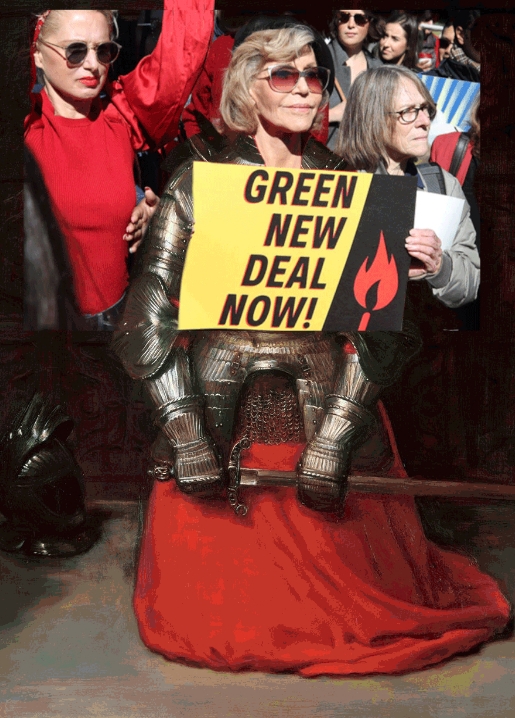
Well-known figures in climate activism are also artistically reinterpreted. In “Jane of Arc” (2026), Stephan Groß transforms actress and climate activist Jane Fonda into the heroine of a rally for the energy transition. Clad in armor and wielding a sword, she merges with a historical painting by John Everett Millais in the photomontage.
Other works focus on women whose commitment is less visible. In “Not the End of the World” (2026), Janet Grau explores women in climate research and climate activism. Climate reports, lecture performance, puppetry, stop-motion, and data visualization combine to form a work about those women whose daily commitment in politics, science, and society often remains in the background.
Between Activism, Care, and Social Roles
“Women. Life. Climate.” is not limited to classic images of activism. The exhibition also asks how societal expectations of women shape their approach to the climate crisis.
Maria Korporal addresses female reproduction and care in the context of climate discourses in her installation and live performance “Cat Lady for Climate” (2026) – a field that lies between social recognition and devaluation. Andrea Striesova’s interactive work “Climate Hate” (2026), in turn, examines digital violence against women and shows how hatred and hostility can influence social engagement and climate protection.
The question of personal responsibility and everyday actions runs through further works. Robin Romanski takes up his mother’s statement: “I have never drunk Coca-Cola in my life!” What initially appears to be a casual personal decision becomes an example of everyday consumption and the possibility of taking on social responsibility through individual choices.
Motherhood is also discussed as a political and ecological issue. In “Maybe Our Mother Didn’t Want Us” (2022), Ekaterina Kovalenko addresses the ambivalence of motherhood and the ecological crisis, relating the fragility of the human body to the vulnerability of the planet. Lioba von den Driesch explores womanhood, different ideas of motherhood, and political responsibility within the family in her installation “Mother’s Day” (2025).
Global Perspectives on the Climate Crisis
The exhibition also looks beyond Europe. In her painting “Máxima Acuña”, Ivonne Portillo Sierra tells the story of the Peruvian farmer and activist of the same name, who was awarded the Goldman Environmental Prize in 2016 for her efforts to defend her homeland in the high Andes.
Gosia Hejnat combines personal travel experience with a global perspective on resources and consumption. Her assemblage “ONE DOLLAR PHOTO” (2026) addresses global power structures, consumption, and resource scarcity through the experience of a backpacking trip. Sandra Becker’s video work “Catching” (2025), on the other hand, makes the barely comprehensible consequences of contaminated soils near Nairobi visible.
Other artists translate ecological crises into powerful visual metaphors. In “Cosy 2” (2026) by Monika Thorwart, a seemingly cozy pillow is in flames – the private living room becomes a danger zone. In “Ain”, Elma Riza makes a date palm a symbol of loss and hope, telling of the disappearance of a Tunisian oasis. With the series “Weird Sister” (2021), Aleksandra Sawa creates the image of a warning prophetess in a dystopian future.
From the Female Body to the “More-Than-Human” World
Another focus of the exhibition is the relationship between the female body and the environment. In her video performance “The Vivid Void: more than human”, Alina Tofan connects a female-read body with a non-human body, referring to its vulnerability. In Jiaxiao Ji’s “She Who Fades Away” (2026), a female-read portrait increasingly merges with its environment until the boundaries between human and surroundings are barely recognizable.
In “Mrs. Boss” (2026), Erika Szentgyörgyi breaks with stereotypical notions of femininity and presents a cubist-geometric figure with a strong gesture. Judith-H. Boy combines fashion, consumption, and criticism of inadequate fair trade in coffee production in “RADIATION PROTECTION” (2024): a walkable and wearable robe made of coffee aluminum becomes a sculptural and political statement.
Art Creates Visibility – and Demands Responsibility
“Women. Life. Climate.” understands climate art not just as a depiction of a crisis. The works ask who becomes visible, who is heard, and who takes responsibility. They tell of activism and resistance, but also of care, motherhood, consumption, power, and societal expectations of women.
Thus, the exhibition presents the climate crisis from a perspective that connects political, ecological, and social issues. The artists make it clear: climate protection is not solely a matter of technological solutions. It is also a matter of social structures, participation, and responsibility.
Accompanying Program
The exhibition is accompanied by an extensive event program. At the vernissage on August 7, 2026, at 7 PM, in addition to a welcome by Tom Albrecht, there will be an introduction by Katja Hock, music by Puzzls, and performances by Maria Korporal and Judith-H. Boy. An artist talk will take place on August 14.
A panel discussion on August 21, 2026 brings together women from various climate professions to discuss challenges, opportunities, and perspectives. The discussion will be moderated by sustainability expert Nathalie Wenker. Prof. Dr. Stefanie Kaboth-Bahr, Dr. Andrea Nakoinz, Nina Kreutzfeldt, and Insa Kehlenbeck will be on the panel.
During Berlin Art Week, the program will be supplemented by further events: On September 9, Caroline Gunderson from the Hertie School will speak on how art can promote awareness, empathy, and action. On September 11, Dr. Meike Brückner from HU Berlin will address the question “Who cares for the future?” and the connections between climate research, gender, nutrition, and justice. On September 12, another performance by Maria Korporal will follow.